
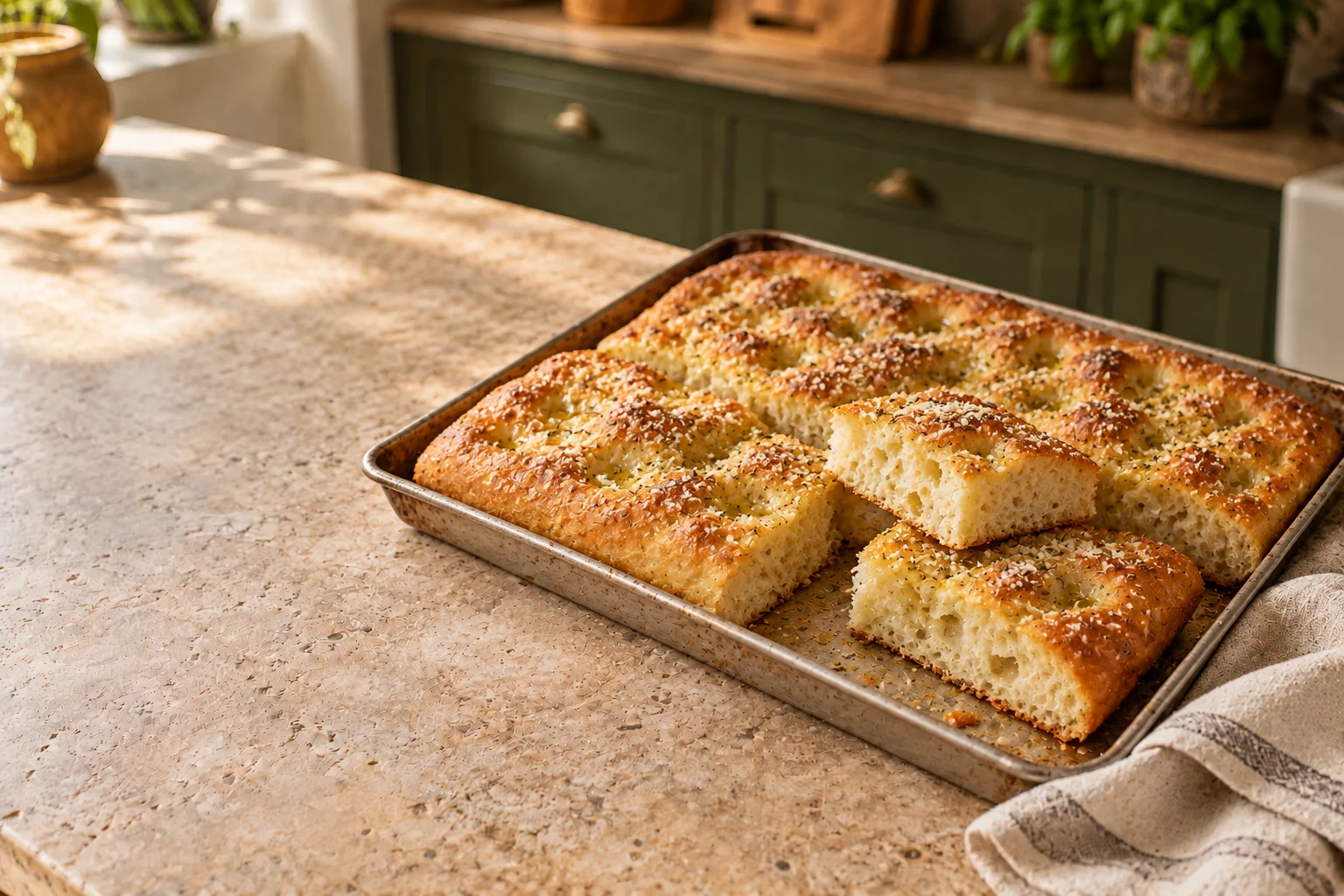
Focaccia all’anima di lasagna
Focaccia with a moist crumb, olive oil and a little Parmesan and herbs. The dough rises in the fridge. Serve it alongside lasagne, soup or a stew.
Jump to the recipe ↓AI-generated illustration.
Ingredients now shown for 4 people as a side dish.
Optional: keep the screen awake while following the recipe. Uses more battery.
Favourites are saved in this browser, without signing in.
SAPIDUS · Flavour. Curiosity. Joy of food.
Focaccia all’anima di lasagna
4 people · About 15–21 hours, including 12–18 hours cold fermentation
Equipment: Mixing bowl and metal tin, about 25 × 35 cm for the original dough
Quantities follow your selection; time and temperature do not scale automatically.
Ingredients
Dough
- 300 g plain wheat flour
- 225 ml water
- 1 g dried yeast, or 2½ times the amount of fresh yeast
- 5 g cane sugar
- 6 g salt
- 1 tbsp olive oil for the dough
Tin and topping
- 1 tbsp olive oil, divided between tin and surface – suggested amount
- 15 g finely grated Parmesan – suggested amount
- ½ tsp dried oregano – suggested amount
- A little fresh basil after baking, optional
Allergens: Wheat/gluten and milk from Parmesan.
Method
Mix the dough
Mix yeast into water and stir in flour, sugar, salt and oil. Work together until all flour is moistened. The dough should be sticky; do not knead in extra flour to make it dry.
Let time do the work
Cover the bowl and refrigerate for 12–18 hours with room to rise. The dough should become visibly airy. Use a large enough bowl.
Warm slightly and transfer to the tin
Leave the bowl at room temperature for about one hour. Grease the tin well with some topping oil. Gently turn in the dough and stretch slowly towards the edges. If it springs back, wait a little before continuing.
Prove and dimple
Let rise in the tin for about 1–1½ hours until airy and wobbly. Drizzle the remaining oil over the top and gently press fingertips into the dough. Sprinkle Parmesan and oregano over; avoid large exposed heaps of cheese.
Bake and cool
Bake at 230 °C conventional for about 20–25 minutes until golden and cooked through. Watch the Parmesan near the end. Lift the bread from the tin and cool on a rack. Add fresh basil after baking if desired.
https://sapidus.no/en/oppskrifter/kaldhevet-focaccia
About portions and timing
Cuisine: Italian-inspired
Tick ingredients as you prepare them and steps as you finish them.
0 items checkedMethod
Mix yeast into water and stir in flour, sugar, salt and oil. Work together until all flour is moistened. The dough should be sticky; do not knead in extra flour to make it dry.
Cover the bowl and refrigerate for 12–18 hours with room to rise. The dough should become visibly airy. Use a large enough bowl.
Leave the bowl at room temperature for about one hour. Grease the tin well with some topping oil. Gently turn in the dough and stretch slowly towards the edges. If it springs back, wait a little before continuing.
Let rise in the tin for about 1–1½ hours until airy and wobbly. Drizzle the remaining oil over the top and gently press fingertips into the dough. Sprinkle Parmesan and oregano over; avoid large exposed heaps of cheese.
Bake at 230 °C conventional for about 20–25 minutes until golden and cooked through. Watch the Parmesan near the end. Lift the bread from the tin and cool on a rack. Add fresh basil after baking if desired.
Get to know the spices in this dish
About this version
The cold-fermented version is retained: 600 g flour, 450 ml water and 2 g dried yeast or 5 g fresh yeast in the original dough. Eight side-dish portions, tin size and topping amounts are standardised suggestions.
Good to know before you cook
Choose the right tin
A tin about 25 × 35 cm suits the original dough for eight side portions. For four, use a smaller tin, about 20 × 20 cm. Keep a similar dough thickness when scaling.
Reheat
Use 180 °C conventional, or 160 °C fan. Cover loosely with foil. A whole tin usually needs 10–12 minutes; individual pieces 5–7 minutes.
Watch the rise rather than the clock
Fridge temperature and yeast affect timing. The dough should have visible air bubbles before baking. The original dough contains 75 % water relative to flour.